

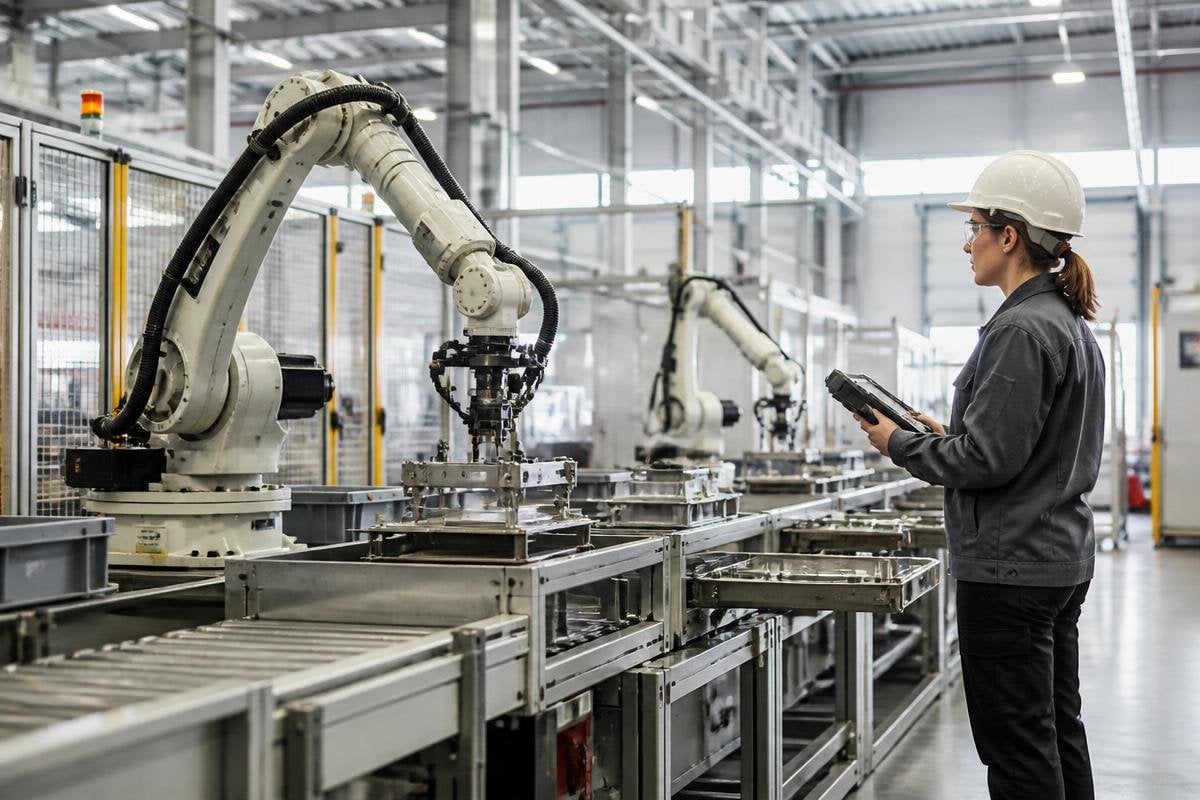
Robots are closest to useful deployment in industries where tasks repeat, workspaces stay controlled, and success is easy to measure. The strongest candidates are factories, warehouses, farms, and some hospital operations, but each has a different limit.
- Factories suit robots because parts, tools, and motions stay in fixed places.
- Warehouses gain from mobile robots when routes and handoff points are clear.
- Farms and hospitals have useful tasks, but changing conditions make deployment harder.
This is a task-based guide, not a ranking of current sales or deployments. Without a supplied evidence pack, the sound way to judge readiness is to look at the work itself.
Factories have the clearest path
Manufacturing remains the easiest place to justify a robot when the same operation runs through every shift. A robot can load a machine, move a part, apply adhesive, or inspect a surface while fixed tooling keeps the task within known limits.
That setup gives engineers three useful controls: the part arrives in a known position, the robot has a fixed route, and the result can be checked against a set measurement.
If the task needs steady force or repeated motion, a robot can also keep its speed and path more consistent than a person working through a long shift.
The limit is change. A factory that makes many low-volume products may spend more time changing grippers and programs than the robot spends working. A flexible arm helps, but each new part still needs testing, safe motion limits, and a way to spot errors.
Warehouses are ready where routes stay clear
Warehouse robots work best on transport jobs: moving bins, pallets, or shelves between known points. Autonomous mobile robots use sensors such as LiDAR to map nearby objects and adjust their path, while fleet software assigns jobs and controls traffic.
The task looks simple until people, carts, damaged packaging, and blocked aisles enter the route. A transport robot can cover the same floor many times, but it still needs safe stopping distances and a clear handoff with a worker or another machine.
Those route limits make a warehouse claim testable. Warehouse robot reports from Robot24.com can connect a stated task with the machine, site, and handoff rules behind it. That points to the clearest early use case: repeated trips between known pickup and drop-off points.
The best warehouse case is a repeated route with known pickup and drop-off points. Picking mixed items from crowded shelves is harder because the robot must find each object, choose a grip, and check that the item is secure.
Farms offer value with harder conditions
Agriculture has many tasks that repeat across large areas, including crop monitoring, targeted spraying, and some forms of harvesting. A robot can carry sensors through a field or follow a planned row, giving operators a record of crop conditions without sending a person over every section.
The ground changes after rain. Plants vary in size, rows may be uneven, and dust can affect cameras and moving parts. Those conditions raise the cost of sensing and maintenance, so a farm robot needs a clear task and a strong reason to work without constant human control.
Harvesting is the harder case. A machine must find ripe produce, reach it without damage, and place it in a container. Each step adds uncertainty, which makes a controlled factory task easier to automate than a field task with similar hand motions.
Hospitals need narrow tasks first
Hospitals have predictable jobs that can suit robots, such as moving supplies, carrying meals, or sending waste to a collection point. These tasks reduce the need for staff to walk through long corridors, but the robot still shares space with patients, visitors, beds, and emergency movement.
A hospital robot also needs clear rules for doors, lifts, cleaning, and human contact. A machine that carries a sealed cart has a simpler safety case than one that touches a patient or handles an open tray.
The work is ready when the robot can stay in its lane and the hospital can measure the result. A broad promise about care is harder to test than a recorded delivery time between two rooms.
Check the task before buying the robot
Use this short decision guide before you compare robot models:
- Map the work: record the route, cycle time, load, and handoff point.
- Count exceptions: note how often people must fix parts, clear paths, or restart a task.
- Set the test: choose one result, such as completed moves per shift or missed picks.
- Price the support: include grippers, charging, software, training, repairs, and floor changes.
- Plan the fallback: decide who takes over when the robot stops or finds an unknown object.
I’d put factories first for most buyers because controlled spaces make the cost and safety case easier to check. Warehouses come next for transport work, while farms and hospitals need narrower pilots built around one measurable job.
The next useful question is not which industry gets a robot first. It is which task has a fixed route, a known load, and a result someone can measure every shift.
